


The statistics around employee onboarding are uncomfortable reading for most HR leaders. The average total cost of onboarding a single new employee, when recruitment, administrative processing, IT provisioning, and the first-90-day productivity ramp are fully accounted, sits at approximately $4,700 per hire according to SHRM benchmarking data. Organizations with over 1,000 employees who hire 200 people per year are spending nearly $1 million annually on the onboarding process alone.
More concerning than the financial cost is the opportunity cost of getting it wrong. Research from BambooHR found that effective onboarding improves new hire retention by 82% and accelerates time-to-productivity by over 70%. Yet only 12% of U.S. employees report that their company provides a great onboarding experience. A substantial 36% of employers still have no structured onboarding process at all.
The gap between what onboarding could be and what it currently is, for most organizations, is not a strategy problem. It is an execution problem. Onboarding requires the coordination of many independent systems: IT account provisioning, HR database records, legal compliance documentation, benefits enrollment, equipment logistics, training assignment, and first-day scheduling. Each of these functions operates in a different software system, owned by a different team. The manual coordination overhead between them is where weeks of delay, missed steps, and poor first impressions accumulate.
The Anatomy of Onboarding Delay
Before designing an automation architecture for onboarding, it is worth mapping where the time actually goes. A typical enterprise onboarding experience for a new software engineer looked like this in 2023, before automation was implemented at a mid-sized technology company:
- Day -10 (contract signed): HR manually emails IT to request laptop provisioning. IT ticket created. Estimated delivery: 5-7 business days.
- Day -5: IT emails HR requesting the employee's department, cost centre, and software permissions. HR consults the hiring manager. Response takes 2 days.
- Day -3: Software licenses (Figma, GitHub, Slack, Jira) requested manually by IT. Each requires a separate request ticket to the software team. Average processing time: 1-2 days per application.
- Day 1 (first day): Laptop is not yet configured with the required development environment. Two software licences have not been activated. The new employee has no access to the primary project repository. They spend their first day in onboarding paperwork while their manager scrambles to unblock their access.
This sequence is not exceptional. It is the median experience. And it can be eliminated almost entirely with event-driven automation.
The Event-Driven Onboarding Architecture
The trigger for the entire onboarding automation chain is a single event: contract signed status update in the ATS (Applicant Tracking System). When this event fires, an n8n webhook receives the payload and initiates a coordinated, parallel automation sequence.
Parallel Onboarding Automation Tracks
Track 1 — IT Provisioning (Day -14 to Day -7): Automated ticket creation in Jira Service Management with role-based hardware specifications. Parallel Google Workspace Admin SDK API call to create the employee's email account, add them to relevant Google Groups, and initialize their Drive storage with the standard folder structure for their department.
Track 2 — Software License Provisioning (Day -7 to Day -3): Based on the employee's role and department (extracted from the ATS payload), automated license provisioning to required SaaS tools via each platform's admin API. GitHub org invitation, Slack channel auto-join, Figma team addition, Jira project membership. All automated, all sequential within the track, all running in parallel with Track 1.
Track 3 — HR Documentation and Benefits (Day -10 to Day 1): DocuSign automated trigger for employment contract final signing, tax documentation (P45/P60 for UK, I-9 and W-4 for US), and benefits enrollment initiation. Employee receives a sequenced set of forms with a tracking dashboard showing their completion status.
Track 4 — Manager and Team Preparation (Day -3 to Day 1): Automated Slack DM to the hiring manager with a first-week checklist; team calendar invite for the welcome meeting; automated provisioning of the "Day 1 Welcome Package" in the company intranet with context-specific content for the employee's role.
Measuring the ROI
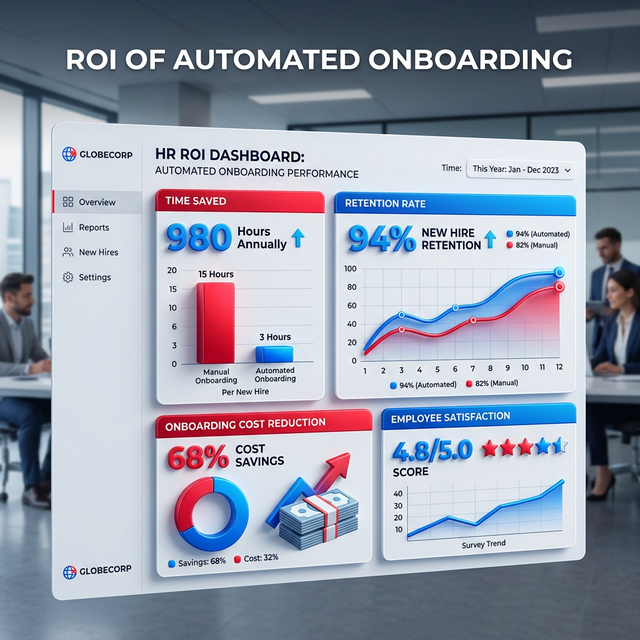
Organizations implementing event-driven onboarding automation consistently report similar outcomes: IT provisioning time reduced from 7-10 days to 48-72 hours; first-day access completion rates improving from 60-70% to 95%+; HR administrative time per onboarding reduced by 40-60%; and measurably higher first-week satisfaction scores from new hire surveys.
At a company onboarding 200 employees per year, reducing the average onboarding administrative time from 8 hours per hire to 2 hours saves approximately 1,200 person-hours annually — equivalent to freeing one full-time HR team member for higher-value strategic work. When multiplied by the $4,700 average onboarding cost and the 82% retention improvement factor from effective onboarding, the ROI calculation becomes compelling rapidly.
Citations & Reference Sources
Want to implement this in your business?
Book a free discovery call with Pratik directly. We'll map out where AI-driven automation can generate the highest ROI in your existing processes.