

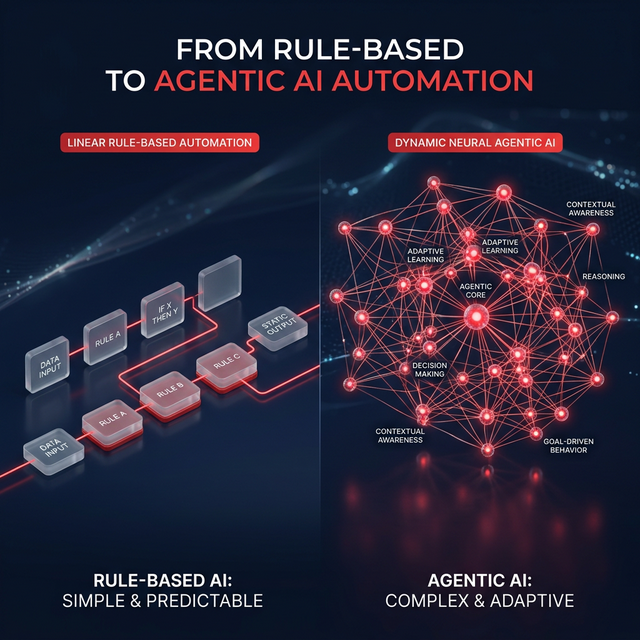
For nearly a decade, Zapier has been the dominant paradigm for business workflow automation. Its "Zaps" — trigger-action pairs connecting more than 7,000 applications — gave non-technical teams the ability to string software together without writing a single line of code. This was genuinely transformative. But in 2025, the limitations of purely deterministic, rule-based automation are becoming painfully visible in enterprise environments. And a new category of tool — the autonomous AI agent — is stepping into the gap.
What IFTTT Actually Means for Enterprise Complexity
"If This, Then That." The underlying logic driving every Zapier workflow, every Make scenario, every traditional automation. The model works beautifully when your data is clean, your formats are consistent, and your edge cases are few. But enterprise reality is messier than this.
A customer sends an email that says "I need to reschedule" — does your automation route it to a cancellation flow or a rebooking flow? How does it know? A vendor invoice arrives with an unusual line-item structure that doesn't match any of your 47 predefined OCR templates. Does the workflow fail silently, fail loudly, or route intelligently to a human? These are not exotic edge cases. These are Monday mornings in any mid-market company.
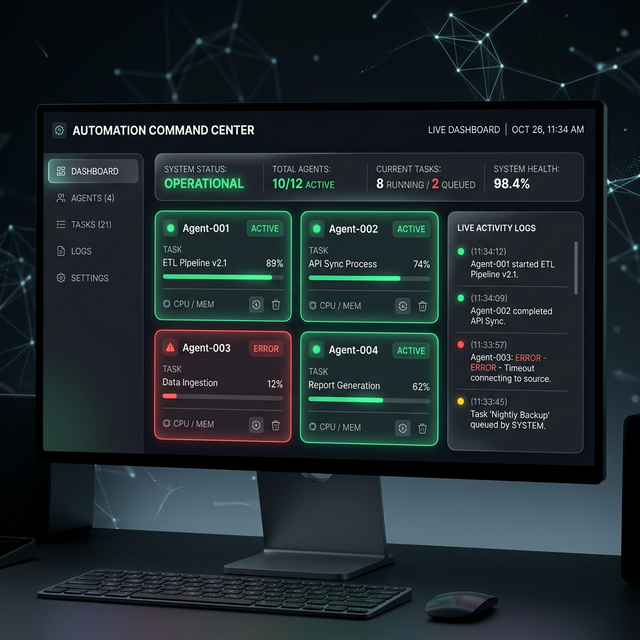
"Enterprises don't operate in clean, structured JSON schemas. They operate in the messy, unstructured reality of human communication — and deterministic automation breaks when reality refuses to be deterministic."
The Data: AI Agents Are Not a Trend — They Are a Market Shift
The numbers tell an unambiguous story. According to Grand View Research, the global AI agents market was valued at $5.4–5.9 billion in 2024 and is projected to hit approximately $7.6–8.34 billion by 2025, growing at a CAGR between 38.5% and 47%. Some forecasts place the 2030 market at over $50 billion.
Enterprise adoption is equally striking. As of late 2025, 52% of enterprises actively deploy AI agents, with 39% running more than ten agents in production (Punku.ai Enterprise AI Report, 2025). A 2025 Google Cloud study found that 74% of executives reported a return on investment from AI within 12 months. Gartner predicts that by 2028, 33% of enterprise software applications will incorporate agentic AI capabilities, up from less than 1% in 2024.
For comparison: in 2024, Zapier generated $310 million in revenue with 100,000 customers, while n8n — the open-source, developer-focused alternative — reached $40 million in revenue with accelerating growth. The market is bifurcating: simpler automation for simple tasks, and intelligent agents for complex orchestration.
Where Zapier Excels (and Where It Hits the Ceiling)
To be clear: Zapier remains an excellent tool for specific use cases. Its strengths are genuine. Over 7,000 native integrations, a near-zero learning curve, enterprise-grade SOC 2 Type II security, and a visual interface that empowers marketing and operations teams without requiring developer involvement. For high-volume, stable, predictable workflows — send a Slack notification when a Stripe payment succeeds — Zapier is arguably the best tool available.
The ceiling emerges when the workflow requires judgment. Zapier cannot:
- Read an unstructured email and correctly determine whether the customer is complaining, requesting a refund, or simply asking a question before routing it appropriately.
- Handle API responses that deviate from the expected schema without halting the entire workflow.
- Dynamically replan a workflow mid-execution when a dependency fails, choosing an alternative path rather than throwing a fatal error.
- Self-correct when data transforms produce unexpected outputs, without explicit conditional branches manually coded for every edge case.
The n8n Architecture Advantage
n8n, the open-source Berlin-based platform, approaches automation from a developer-first perspective. With approximately 400–1,000 native node integrations (far fewer than Zapier), it compensates with extraordinary extensibility. Any API in the world can be connected via HTTP Request and Webhook nodes. Custom JavaScript and Python can be executed inline. And critically for the agent era, n8n has built native LangChain integration, enabling the orchestration of LLM reasoning nodes alongside conventional API steps.
This matters because the optimal enterprise architecture in 2025 is a hybrid: deterministic orchestration for the stable scaffolding, cognitive agents for the ambiguous tasks. An n8n workflow can handle authentication, routing, error logging, and retry logic deterministically — while delegating the "should this email go to Sales or Support?" decision to a Claude or GPT-4o agent node that reasons about the content before routing.
The Hybrid Agent Architecture
Layer 1 — Deterministic Orchestration (n8n): Manages credential authentication, API connections, error handling, retry logic, and structured data transformation. This layer is fast, reliable, and auditable.
Layer 2 — Cognitive Agent Nodes (LLM Integration): Deployed specifically for steps requiring judgment: classifying intent from unstructured text, extracting entities from variable-layout documents, making routing decisions based on context, and generating structured outputs from messy inputs.
Layer 3 — Human-in-the-Loop Gates: For any action that is destructive, irreversible, or exceeds a financial threshold, the workflow pauses and requires a human to approve before execution continues. This maintains governance without sacrificing automation efficiency.
Zapier's Own Response: The Emergence of Zapier Agents
Zapier has clearly read the signals. In 2024, the company launched "Zapier Central" — subsequently rebranded as Zapier Agents — an experimental AI workspace allowing users to create and train AI bots that automate tasks across Zapier's 6,000+ application ecosystem. Zapier Agents can process live data from Google Sheets, Notion, and HubSpot, and execute actions autonomously based on natural language goals rather than explicit trigger-action pairs.
This is a meaningful evolution. However, independent assessments suggest that Zapier Agents still operate within a fundamentally constrained architecture compared to truly open-ended agent frameworks, and remain better suited for SMB workflows than complex enterprise orchestration requiring multi-agent collaboration, persistent memory, or deep customization.
What This Means for Your Automation Strategy
If your organization's automation estate consists primarily of notification workflows and data-sync pipelines, Zapier remains an appropriate and cost-effective choice. But if you are attempting to automate complex, judgment-heavy processes — multi-vendor contract management, intelligent customer triage, automated financial reconciliation, regulatory compliance monitoring — then 2025 is the year to seriously evaluate agent-native architectures.
The cost equation has also shifted dramatically. Agent-driven workflows that previously required armies of analysts or expensive custom software development can now be deployed for a fraction of the cost, with measurably faster ROI. According to McKinsey's landmark 2023 report on generative AI, the technology could add between $2.6 trillion and $4.4 trillion in annual economic value globally — with customer operations and back-office automation representing some of the highest-impact opportunities.
Citations & Reference Sources
Want to implement this in your business?
Book a free discovery call with Pratik directly. We'll map out where LLMs and robust automation can generate the highest ROI in your existing processes.